
How Are Stadiums Paid For? A Primer on Public Financing of Stadiums
This page describes common ways professional sports venues are publicly financed, including taxes, municipal bonds, and other forms of government assistance. Much of the information is drawn from Chapter 10 of This One Will Be Different.
An important lesson is that different taxes may change the distribution of the funding burden somewhat, but there is no way to eliminate the public cost of a stadium by selecting certain tax instruments. Taxpayer-funded stadiums have opportunity costs: devoting resources for one purpose necessarily means not using them for something else. Spending hundreds of millions of taxpayer dollars on a stadium requires extracting that same amount of wealth from the tax jurisdiction, which means the community no longer has those funds available to use for private and public consumption.
Key takeaway: No matter what funding mechanisms are used to pay for a stadium, the cost of public stadiums is primarily borne by local taxpayers.
Who pays for professional sports stadiums?
Professional sports venue financing has changed over time. At the beginning of the 20th century, stadiums were entirely private endeavors, paid for by team owners. Venues became mostly public projects from the 1930s through the 1970s. Since that time, facilities have largely been public projects with varying levels of private contributions.
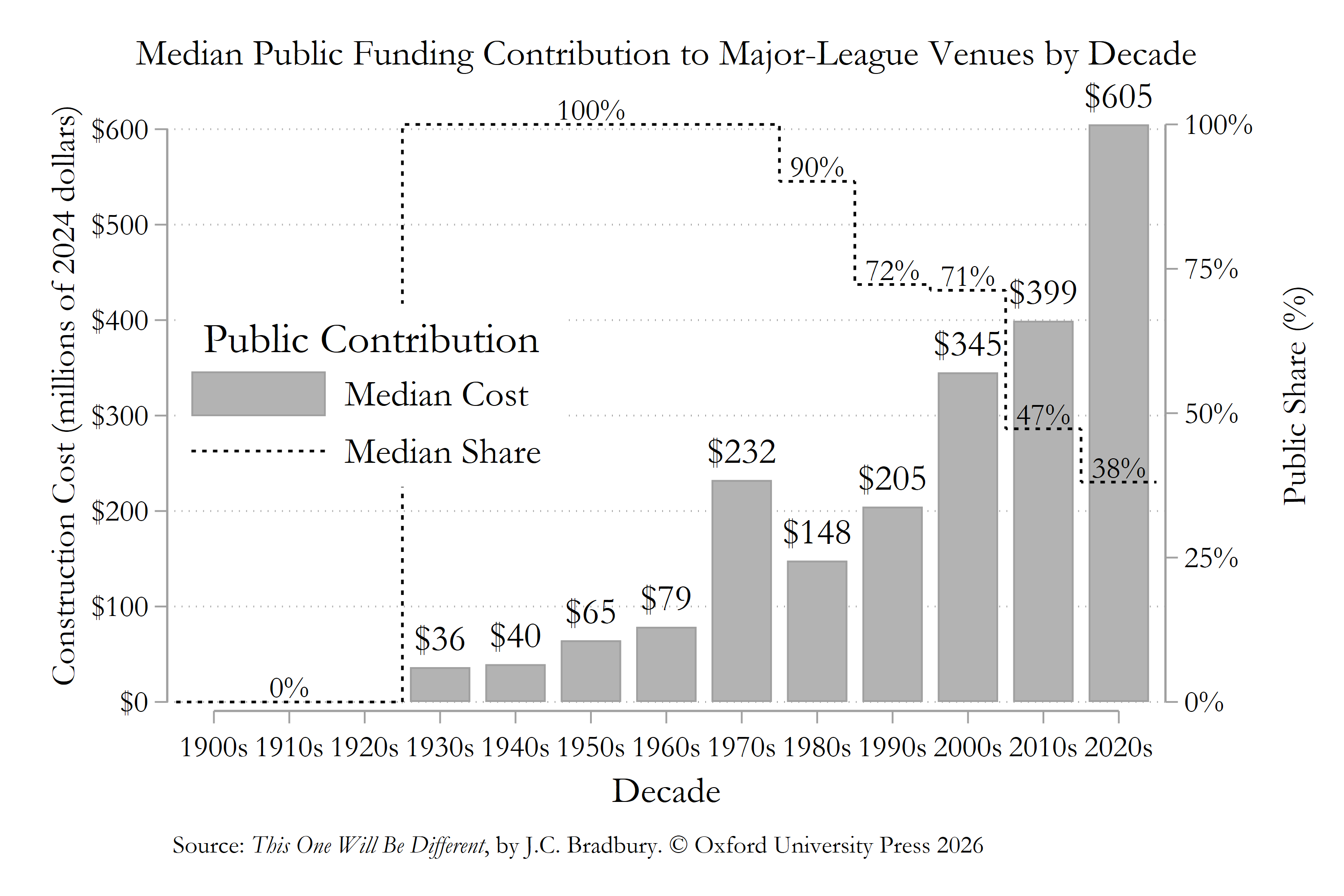
Though the public share has been decreasing since the 1980s, the total public contribution has been growing. The latter amount is what is most important for evaluating policy, because it reflects the increasing opportunity cost from allocating public resources to venue projects. For example, a public subsidy of $500 million requires that $500 million be reallocated from other government projects or collected from taxpayers. It does not matter whether that represents 30%, 50%, or 100% of the total cost; the opportunity cost of what those funds could be used for (publicly or privately) is the same.
Is it possible for stadiums to be 100% privately financed?
Yes. Stadiums were originally fully private endeavors, and though public subsidies are now common, many professional sports facilities operate as private venues. The major US professional sports leagues are highly profitable businesses that generate billions of dollars in annual revenue, which is why their teams are willing to hire athletes with salaries in the millions of dollars. Professional sports teams are capable of financing their operations without any public assistance.
Is government funding devoted to stadiums really a subsidy, or should it be considered an investment in a public-private partnership?
Because of the shared funding burden, stadium projects are often referred to as “public-private partnerships.” Though it may seem to be an appropriate description of the relationship due to the joint nature of the project, the moniker is misleading. “Partnership” implies that the government is participating in a business partnership, which typically involves investments from private partners who expect to receive a share of future income that reflects the size of their financial contributions. For example, an investor who provides 30% of the cost of the project normally expects to receive 30% of the future income it generates.
However, when it comes to jointly funded venue projects, the financial arrangements operate differently from standard business partnerships. The public-private relationship consists of a public funding contribution without granting rights to future income that flows from the project—the private team partner retains nearly all future revenue. Instead, the supposed public “return” derives from subsequent economic activity that the stadium hypothetically creates, which is presumed to generate sufficient tax receipts that more than cover the cost of the public outlay. In practice this does not happen, as decades of economics research consistently demonstrates that sports venues have limited to no economic impacts that would generate a positive financial return to taxpayers.
Thus, it is more appropriate to describe any public contribution to sports venues as a subsidy rather than an investment, which falsely implies that the government is a business partner in a profit-making venture expected to generate net fiscal benefits for taxpayers.
How are municipal bonds used to finance stadiums?
Stadium construction is expensive, and bonds allow governments to borrow funds they do not currently have, with the promise of repaying the loan from future tax revenue. In many cases, revenues are allocated from dedicated tax income streams—such as special sales taxes or sports district taxes—but governments often back bonds with a promise to repay bondholders even if the tax allocation mechanism doesn’t generate sufficient revenue.
Because governments have the power to tax, they are considered generally good credit risks, which allows them to issue bonds at lower interest rates than private borrowers. Some municipal bonds are exempt from federal taxation, which lowers borrowing costs further and represents another form of subsidy that sports teams often receive. However, to preserve the tax exemption from municipal bond financing, no more than 10% of the debt service generally may be derived from or secured by private-use property or payments. Thus, stadiums financed with tax-exempt bonds must rely primarily on revenues generated outside the stadium to service the debt.
What taxes are used to pay for sports stadiums?
Municipalities use a variety of taxes to fund sports venue projects, from general fund property and sales taxes to targeted taxes that may seem to be closely tied to associated commercial activity. Below, I review several common tax instruments that have been used to fund sports venue projects.
How are property taxes used to finance stadiums?
Most local governments assess property taxes that go into a general fund to support their basic operations. When municipalities began building stadiums in the middle of the 20th century, they often drew from general fund property taxes to cover the bond debt.
Different tax jurisdictions tend to assess property taxes in their own way, but the taxes collected normally reflect the value of the property.* For this reason, an attribute of taxing property is that it reflects the added value of public amenities. For example, a home located in a city with nice parks and good schools will tend to attract more residents, which results in higher property values that generate higher tax revenue. This allows the jurisdiction to fund more local projects or lower the tax rate needed to maintain its provided services. Thus, if hosting a sports team in a public venue is something that most residents value, then it should be reflected in the increased value of property tax assessments. Economists have looked for this effect, and the evidence is mixed—studies have found positive, negative, and no effects—which suggests that the amenity value of having a hometown team is not large or guaranteed to be positive.
Property tax increases often require voter approval, and when sports venue referendums started to fail in the 1980s, elected officials who promoted stadium projects often relied upon alternate tax sources to fund them.
* In most cases, property is taxed at a rate of an assessed value. For example, where I live in Cobb County, Georgia, the assessed residential property tax value is determined by 40% of the fair market value of the property. This means that the taxable value of a $200,000 house would be $80,000 (40% × $200,000). The taxes owed are determined by a tax rate, which is often expressed as a millage (per $1,000) rather than a percent (per $100). In 2025, Cobb’s total millage rate was 30.13, which would result in a tax bill of $2,410 ($80,000 × 0.03013) for a $200,000 house.
How are sales taxes used to finance stadiums?
Stadiums are sometimes funded from general sales taxes, which devote a share of all purchases in the community to pay for a venue project. For example, the Oklahoma City Thunder’s new arena is funded by an additional 1% sales tax. Like property taxes, sales taxes are relative transparent, and thus voters are sometimes reluctant to approve them in referendums. Though Oklahoma City’s arena plan was approved by a voter referendum, a sales tax measure for a new Kansas City Royals stadium was voted down.
Sometimes sales taxes are assessed in special districts, or attached to specific purchases (like alcohol, hotel rooms, or stadium-district purchases), which I discuss below.
Do stadiums funded by visitor-targeted taxes, like taxes on hotel stays and rental cars, shift the funding burden off local residents?
Some governments fund sports venue projects with taxes on purchases associated with out-of-town visitors, such as hotel rooms and car rentals. The idea is to export the funding costs off residents onto visitors. It would seem that taxing items largely purchased by non-locals would lower the cost paid by area citizens; however, the allocation of tax burdens is not this simple.
Because buyers and sellers adjust their behavior in response to the prices they pay and receive, both sides of a market can bear part of a tax burden, regardless of which party formally remits the tax. Thus, determining tax burdens requires tax incidence analysis, which is an economic concept that is so fundamental that it is taught in introductory microeconomics courses.
I demonstrate how tax incidence analysis is used to identify tax burdens in the following example. An identical fixed-dollar per unit tax (e.g., $3 per hotel room night) is assessed on either buyers (hotel guests) or sellers (hotel owners). The shaded gray boxes reflect the total tax revenue collected by the government and the different shades separate the individual shares contributed by both parties.
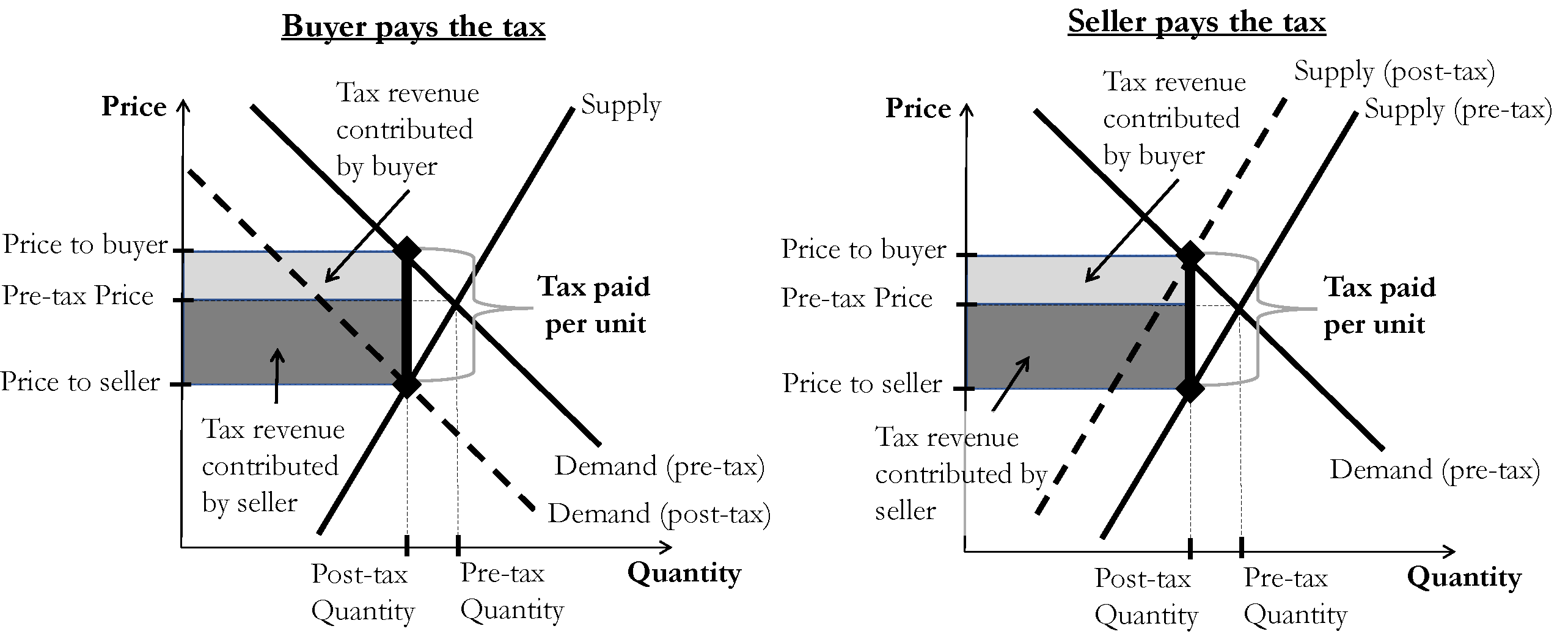
When buyers are responsible for paying the tax (left), it raises the price that they must pay to purchase the taxed good, which results in a reduced willingness to purchase it, effectively shifting the demand function to the left. Sellers are willing to sell fewer units due to the reduced revenue they receive from the lower after-tax price. In this case, sellers are willing to sell more units at a lower price than buyers are willing to buy at a higher price, which is reflected by the relatively steeper slope of the supply function. The end result is that sellers end up bearing a larger burden of the tax in terms of lost revenue (dark gray rectangle) than buyers experience through paying higher prices (light gray rectangle).
When sellers are responsible for paying the tax (right), they receive less revenue per unit sold, and thus they are willing to sell fewer units, effectively shifting the supply function to the left. Some buyers remain willing to pay higher prices per unit, which offsets part of the tax that sellers remit to the government; however, just like when buyers are responsible for paying the tax, sellers end up bearing the greater burden, in terms of foregone revenue paid to the government.
Sellers bear a larger share of the tax burden in both cases, because sellers are less sensitive to price changes than buyers: in economic terms, sellers are more price inelastic than buyers. When buyers are less sensitive to price, they face a steeper (inelastic) demand function and bear a larger share of the tax burden. When sellers are less sensitive to price, they face a steeper (inelastic) supply function and bear a larger share of the tax burden. No matter who pays the tax, the end result is the same, and the government collects tax revenue equal to the sum of the buyer and seller burdens (both rectangles).
This example demonstrates an important lesson of tax incidence: The burden of paying taxes is determined by the relative price sensitivity (elasticities) of buyers and sellers, not by the party who is responsible for paying the tax.
So, who bears the burden of hotel taxes? Empirical research on the subject is somewhat limited, but market conditions for lodging suggest that hotel owners bear a considerable share of the cost. On the buyer’s side, guests may respond to the added expense of hotel taxes by staying fewer nights, sharing rooms, or traveling to an alternative tourist destination. On the seller’s side, hotels have a fixed number of rooms, and thus can only respond by raising prices when consumer demand is high and lowering prices to fill vacant rooms. Therefore, hotels may bear a substantial share of the burden through lower pre-tax room rates and reduced revenue.
As for car rentals, buyers have many choices to get around a city—such as ride shares, and public transportation—and car rental agencies can move unrented cars to other markets. In general, car rental taxes are easily avoided by both buyers and sellers, and thus raise very little revenue from visitors.
And while sports events are often touted as tourist drivers that bring new spending into town, economics research suggests that tourism effects from sports venues and events are small. In addition, most of the people who attend games are locals, who do not stay in hotel rooms; yet, hotel taxes are charged year-round and can be costly to the overall hospitality industry.
How are sin taxes used to fund stadiums?
Some communities raise revenue for sports venue projects by allocating taxes from sales of vices, such as alcohol and tobacco, or by using gambling proceeds. Though the funding burden does not fall equally on all citizens, these revenues are still derived largely from local residents and businesses that buy and sell these products. These may be appropriate items to tax, but they are unrelated to stadium-generated commerce. Using the funds to finance a sports venue also carries the opportunity cost of not devoting the revenue to other public priorities.
How are ticket taxes and facility fees used to fund stadiums?
It’s common for stadium financing plans to include a tax on tickets or in-stadium purchases that go toward funding the venue. An attribute of these taxes is that the individuals who consume the benefits are paying some of the costs. However, if customers can pay off the cost of the venue with their attendance, then there is no need for government to fund the venue at all. Team owners could self-fund the stadium by charging higher ticket prices, and no one would have to incur the administrative costs of collecting and distributing the tax revenue.
Ticket taxes have the political advantage of implying that users are paying for the venue—they are only paying a small part—but team owners dislike taxing attendees, because it lowers the private revenue they collect. In most cases, venue-assessed taxes make up only a small part of the public funding plan, with the bulk of funds coming from other tax sources.
How do special stadium districts and tax increment financing (TIF) pay for stadiums?
Using the tax increment financing (TIF) model of taxing economic activity within stadium districts is an increasingly common funding strategy being employed to pay for stadiums. The expectation is that stimulated new development in the TIF district will generate future tax revenue that can be used to pay off the stadium. This may involve implementing new taxes (e.g., sales, property, hotel) or reallocating existing tax collections in the area to fund the project.
Because stadium-district taxes collect revenue from nearby commerce, they are often pitched as a way to pay for a public sports venue without actually raising taxes, based on the rationale that the income derives from stadium-related spending. However, this presumption fails to account for where the stadium district spending comes from.
It is well documented that stadiums do not create new economic activity, they reallocate existing spending. The same is true for commerce within a stadium district. Money spent at stadium-district establishments comes at the expense of less spending outside the TIF district. For example, customers of restaurants within the special tax zone would have otherwise patronized restaurants outside the area, thereby reducing the income of non-district restaurants.
The reality is that stadium-district taxes are paid primarily by local residents who reallocate their spending to the district, without creating any new wealth that can be used to pay for the venue. And the taxes collected from non-district establishments that were previously used to fund other government services is also reduced. This means that revenue previously available for other public priorities is instead devoted to paying off the stadium and, in some cases, developing the surrounding commercial or entertainment district.
What tax breaks do stadiums and teams receive?
Stadiums often benefit from tax exemptions and abatements. Sales tax exemptions are sometimes granted on construction materials, and because most stadiums are publicly owned, they are not taxed as private property. These exemptions represent a cost to the taxing jurisdiction because they result in lost revenue that private businesses pay to cover municipal services from which they benefit, such as public safety and transportation infrastructure.
Public policy researcher Geoffrey Propheter’s book Major League Sports and the Property Tax: Costs and Implications of a Stealth Tax Expenditure provides an excellent summary of tax breaks often provided to stadiums. He estimates that the tax benefits from government ownership of stadiums translated to an additional $22 billion in foregone local government revenue over the remaining lives of venues active in 2021 (in 2024 dollars).
Who pays for stadium operations and maintenance of public stadiums?
Responsibility for daily operations and regular maintenance vary across facilities. Obligations of the team tenant and public landlord are normally spelled out in stadium operating agreements. Urban planning scholar Judith Grant Long describes many common working agreements between teams and municipal landlords in her book Public-Private Partnerships for Major League Sports Facilities.
Teams do sometimes pay rent, which is intended to compensate for taxpayer contributions to facility upkeep, but team lease contributions tend to be insufficient to cover the costs. Long observes that the public is more likely to hear about rent paid by teams than about taxpayer commitments, yet: “there is little actual evidence that leases produce significant net revenues. …The problem is that the extent of operating expenses that public partners agree to take on in these agreements offsets all, or nearly all, of these revenues” (p. 100).
Do stadiums generate enough tax revenue to pay for themselves?
Economics research consistently finds that building stadiums and hosting sports venues do not generate sufficient revenue to cover typical levels of public subsidies. This is because most commercial activity that occurs in and around venues is spending that is transferred from elsewhere in the local economy. Thus, taxes collected from stadium-related spending cannot automatically be counted as new revenue, because much of that spending would have generated tax revenue elsewhere in the local economy.
There is no costless way to raise revenue to cover the cost of building a new stadium. If $500 million of public funds are collected to go to the stadium, that is $500 million reallocated from elsewhere in the economy that could have been spent on other public or private purchases.
What is fiscal illusion, and how does it influence public stadium financing?
The public finance concept of fiscal illusion involves using fiscal-policy instruments that make a policy choice appear less costly or more beneficial to taxpayers than it actually is. Because sports venue projects tend to be viewed more favorably by elected officials and local leaders, their funding plans are often designed to make them more appealing to the general public. Many taxes used to fund stadiums discussed above are chosen not because they are the most efficient way to raise revenue, but because they foster the fiscal illusion that they are worthwhile public investments.
First published: August 9, 2026
About the author
J.C. Bradbury is a professor of economics at Kennesaw State University. His research focuses on sports economics, public finance, and local economic-development policy. He is the author of This One Will Be Different: False Promises and Fiscal Realities of Publicly Funded Stadiums, published by Oxford University Press.
Related resources
- Do Sports Stadiums Help Local Economies? — A primer on the economic effects of stadiums.
- How Much Do Sports Stadiums Cost? — Construction costs, public subsidies, renovations, and historical trends.
- Stadium Economics — Articles, research, videos, and public presentations.
- This One Will Be Different — A comprehensive examination of publicly funded sports stadiums.